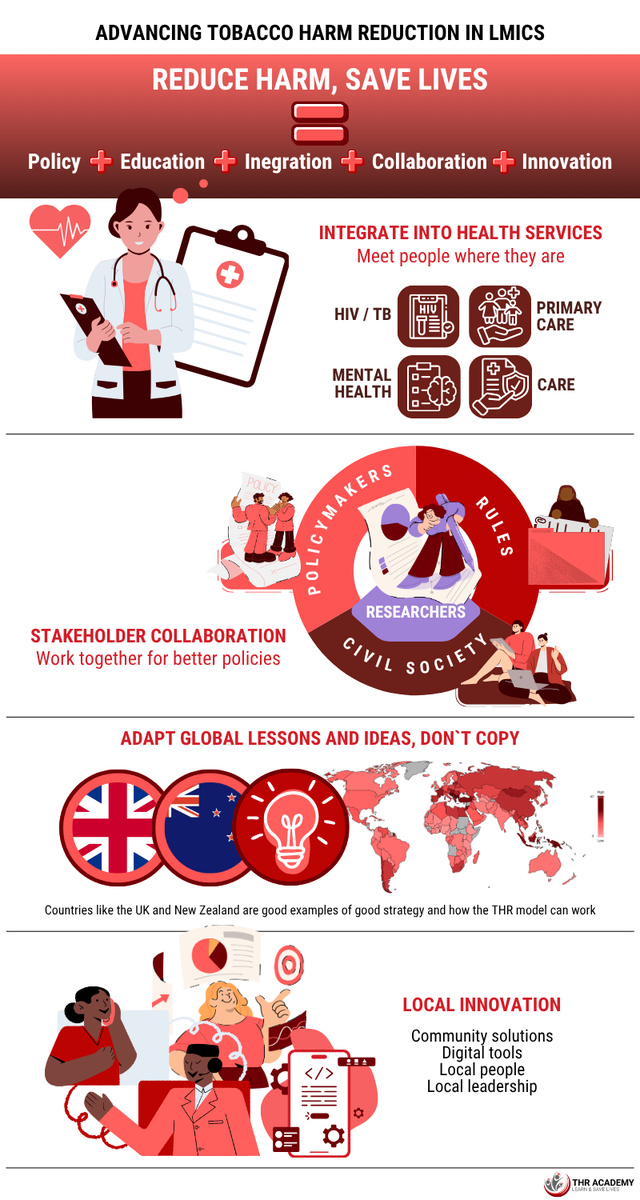
Local innovation: LMIC-led solutions
Local innovation is central to effective THR in LMICs, where imported models often fail to fit local health systems, cultures, and regulatory capacity. The Tobacco Harm Reduction Scholarship Programme, delivered by KAC, illustrates how locally grounded research and intervention can translate global THR evidence into practical, context-appropriate action. Through this programme, LMIC scholars are leading context-specific research and interventions that respond directly to local social norms, health system constraints, and regulatory realities. Rather than replicating high-income country models, this body of work demonstrates how global THR evidence can be translated into locally feasible and credible solutions.
Across many LMIC settings, scholars supported by THRSP are generating applied evidence, testing practical interventions, and developing culturally appropriate communication strategies. Their work focuses on real-world implementation—how to reach people who smoke through existing health services, how to communicate harm reduction in local languages, and how to operate within limited regulatory and enforcement capacity. This approach prioritises feasibility, affordability, and public trust, ensuring that THR strategies are relevant to everyday practice rather than abstract policy ideals.
More than 180 THRSP scholars, across 50 countries, have implemented a wide range of locally driven initiatives, including digital and mobile-based education using SMS, social media, and WhatsApp platforms; training pharmacists, nurses, and community health workers on safer nicotine products; translating scientific resources into local languages; and adapting harm reduction messages into radio programmes, community dialogues, and other culturally resonant formats. Many have also produced country-specific research to inform national debates on tobacco control and harm reduction. Together, these initiatives show how LMIC-led scholarship converts evidence into action.
The central lesson is that local innovation is not optional but essential for effective THR. When LMIC scholars lead research and implementation, harm reduction strategies gain legitimacy, cultural relevance, and sustainability. The next section of this module highlights three concrete examples of LMIC-led THR initiatives, illustrating how local innovation directly drives effective tobacco harm reduction in practice.