WHO’s role and global policy dynamics
The World Health Organization (WHO) has a major influence on how countries, especially LMICs, approach tobacco and nicotine regulation. Because WHO guidance often serves as the foundation of national health policy, many LMICs rely heavily on its recommendations when local regulatory capacity is limited.
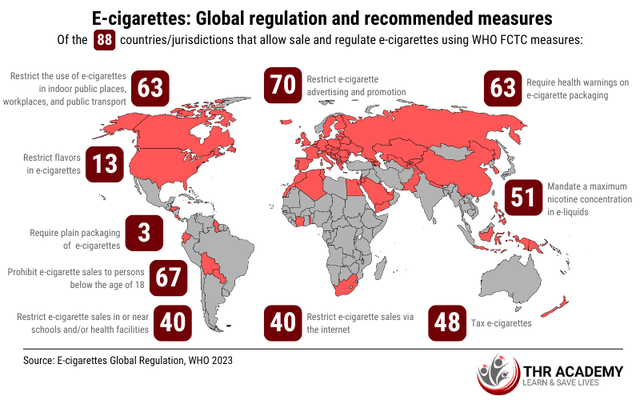
However, WHO’s position on tobacco harm reduction (THR) and safer nicotine products (SNPs) remains cautious and often negative, framing these products primarily as threats to tobacco control rather than as potential tools for reducing harm [^1]. This framing strongly shapes how LMICs interpret or defer to WHO advice.
Many governments adopt WHO’s stance without adaptation, lacking the scientific resources to evaluate the evidence independently. As a result, several LMICs have introduced bans or strict restrictions on e-cigarettes, heated tobacco products, and nicotine pouches—even in the absence of local evidence suggesting significant harm.
Countries that might otherwise explore risk-proportionate regulation often avoid doing so for fear of diverging from WHO-endorsed policy. This creates a form of policy dependence in which international approval outweighs local needs and experimentation.
This deference contributes to policy inertia. When local research capacity is weak, policymakers struggle to generate or interpret new data on the risks and potential benefits of SNPs. Restrictive policies then persist unchallenged, reinforcing WHO’s conservative stance and limiting the development of evidence that could support more nuanced approaches.
WHO has played a crucial role in advancing global tobacco control, but its limited engagement with harm reduction has had unintended consequences for LMICs. A more balanced, evidence-driven approach is needed—one that acknowledges both the risks and the potential public health value of safer nicotine products. Supporting LMICs to interpret WHO guidance critically and to build their own research base is essential if THR is to contribute to health equity rather than be constrained by global policy caution.